This is something that has always made me mad with college, the fact that you have to pay an arm and a leg for a book that if you don't get, you would fail the course. Walking around campus you can't help but notice the tag lines in many windows guaranteeing the "Lowest Text Book Prices." This is such a false statement on so many different levels. The fact that they are false advertising, makes me mad, but the fact that every book store has that same slogan posted tells me that not all of them can be true. I know that the text book industry on a college campus is highly competitive so the need for advertisement is key, but is it truly that competitive. I would say that the competition between the stores themselves is huge, but aren't they all making a profit? They all over price the books, because when you try and sell a $100 book back, you get maybe $1o, if you haven't marked in it at all. And don't even try to return a book, if you don't have a receipt or the week leeway time you have is up, sorry, but you are out of luck. The bookstores are a necessity, yes, but why do they feel the need to rip broke college students off?
I have found that internet book sites are a great help in decreasing the price. They usually have a much better price to offer and different levels: like if you wanted a crappier book with the binding falling apart, they have that to offer for a much lower price than one marked just like new. Sometimes i am so pleased with using the internet, but what about all these shipping prices and if you need a book for the next class, is it really even an advantage to use the internet? All of these things i ask myself when trying to find the "best deal" for a book that is required, but half the time the teacher never uses it. These campus bookstores all individually act as a monopoly because they know that the consumer, us college students, have to buy the books and there is really no way of getting around it. Together, they aren't a monopoly, but its safe to say that they are in a collusion together to try and screw us. I know price fixing is definitely illegal, but how can we not think that when they all, within a $10 give or take, charge the same price. The profit that these stores make is honestly unbelievable. They have a huge margin of profit, because it costs them nothing to purchase and buyback the books. I guess, i can suck it up and deal with the prices but i will always get mad when its time to buy.
Tuesday, March 10, 2009

Tobacco Substitutes
My roommate comes to me yesterday and tells me he wants to quit smoking for good. He was complaining about how the price of cigarettes at Tobacco International went up 80 cents, and that he couldn't afford his habit anymore. He has been a smoker for about 8 months, and it has been progressively getting worse. Recently he was up to a pack a day. I asked if he was going to just go cold turkey. He said he knew it would be tough but he thought he could do it. I started thinking how his personal demand for cigarettes would be at a quantity of 0. I'm finally thinking like an economist. Thanks Kyle. Anyway, my roommate comes into my room today and gives me the perfect opportunity to come up with another subject for an Econ 200 post. He sits down on my couch, sets down an empty water bottle, and pulls out a can of dip. "Gotta get my fix somehow," he says. Instantly I began thinking how the can of Skoal and his Camel cigarettes were substitutes of each other. As his demand for cigarettes decreased, it increased for Skoal. I couldn't believe what a perfect example my roommate gave me for this class.
The Killers, part 2
If anything, this class has taught me a very valuable lesson as a consumer. As previously blogged about, I mentioned that I wanted to buy The Killers concert ticket at the current black market price but after giving it much thought, I remembered learning that in the experiment we did in class, as it got closer to the end, prices started to drop towards equilibrium and people was willing to sell their 'goods' at a lower price than before even if the profit margin was very tiny because in general, people just rather make some profit than nothing.
Given that, I assume that closer to the date of the concert, ticket prices are going to drop therefore I have decided not to buy the concert tickets right now and instead, closely monitor the rates as time goes by. Hopefully, if things goes as planned, I would be able to purchase the concert tickets at a much lower price than now. I will even wait till just right before the concert starts, hopefully some one would be outside the concert hall auctioning off their tickets!
We'll see!
Given that, I assume that closer to the date of the concert, ticket prices are going to drop therefore I have decided not to buy the concert tickets right now and instead, closely monitor the rates as time goes by. Hopefully, if things goes as planned, I would be able to purchase the concert tickets at a much lower price than now. I will even wait till just right before the concert starts, hopefully some one would be outside the concert hall auctioning off their tickets!
We'll see!
Monday, March 9, 2009
Sophomores forced to live in dorms??
Most universities in the United States force their students and more specifically their freshmen to live on campus housing facilities. In other words, students must live in a dorm at least in their freshman year. Unfortunately, the dorms of our university are pretty overpriced especially for what they offer. I am a sophomore and I still live in a dorm but I can’t complain because the dorm I live in is considered a great dorm compared to the rest of the dorms on-campus. My point is that even though my dorm is decent, it is still really overrated for what it offers. It is pretty obvious that the off-campus housing facilities work as substitutes in my example because the demand for them increases when the price for living in the dorms increases. Not only the dorms are expensive in general but off-campus housing definitely offers more space and privacy. By the end of their freshman year, students have the option to choose between on-campus and off-campus housing facilities. Most of them choose to live off-campus not only because this alternative is cheaper but mainly because they feel that these facilities are better living option and more valuable. But now that the university has been considering of making the sophomores live in the dorms too, they do not have an option and they are forced to live somewhere that they do would not naturally choose. As a result, the students are worse off than before. Moreover, our university’s president argued that by forcing the sophomores to live on the dorms, the off-campus realtors will be forced to fix their apartments’ condition in order to rent them out to the remainder of the students (juniors and seniors). On the other hand, it is argued that the realtors rather than fixing the off-campus housing facilities would simply decrease the prices for the off-campus facilities as the demand for those facilities decrease as well. In my opinion, I disagree with the university’s proposal of forcing the sophomores live on campus because I believe that they sophomores should have options on whether they want to live and on which option is more valuable to them. Instead of forcing the sophomores live on campus, the university should make it more appealing to its students to live on campus either by lowering the prices or by improving the dorms’ condition.
Are Video Games Too Expensive?
Many people would probably say that video games are becoming too expensive, I mean, they do cost $60.00 a piece. It doesn't help that our economy is in a poor condition at the moment. It is a combination of a currently poor economy and higher prices that are causing more and more people to start buying used games rather than buying them new.
Gamestop is one company that has benefited from used game sales, because they get all the profit from the sales of used games unlike for the sales of new games. The Wall Street Journal even had an article about Gamestop, stating that 42% of Gamestop's profits came from used game sales. In fact, it is estimated that Gamestop's revenue for their current fiscal year from used games alone is $2 billion which is $400 million more than their last fiscal year.
This increase in used game sales has caused some changes in game companies selling strategies. Now, a lot of game companies offer an incentive to people who pre-order their game, such as a special in game weapon, vehicle, character, or multiplayer maps. There are also a lot more special editions of games now than there used to be. Special editions of games cost more than regular copies of the game and usually include some cool extras.
I think game companies will start pricing their games more competitively to stave off used game sales. They may even revert back to the price of $50.00 each, even though that is only $10.00 cheaper, I would feel a lot better paying $50.00 for a game than $60.00. I think a better idea than that though, would be to have different prices based on the game. I can honestly say some games are worth $60.00, but there are many others that are not. As an example, I will used the Madden football series produced by Electronic Arts. They release a new Madden game every year, so why should I pay $60.00 for a game that has only a few improvements from the previous years version, new Madden games should probably only cost somewhere between $30.00-40.00.
The $60.00 price tag is probably a necessity however. Video game development has evolved from the Atari days where only one programmer was needed to make an entire game to the present where it takes not only programmers, but producers, game designers, artists, level designers, engineers, and testers. The cost of game development for current consoles is in the millions. Halo 3 cost $30 million to develop and another $10 million in advertising and GTA IV cost a total of about $100 million in development and advertising. Even though the price of $60.00 seems high, it is understandable when you look at how much work actually goes into making a video game in the present, some games even have development times of over two years.
The Rationality of a Frog
According to our book, rational people systematically and purposefully do the best they can to achieve their objectives, given the opportunities they have. If that is so, then I believe rational people are responsible for the slow destruction of our planet. Last week in my biology class we discussed the negative effects humans have on the environment, and it was rather disturbing. You may be wondering at this point why we haven't made a very big effort to change this. One reason for this is because pollution is a negative externality. An externality is the uncompensated impact on person's actions on the well being a bystander or society as a whole. Being the rational people we are, however, we often ignore this negative externality when we make the personal decision to pollute because it does not effect the fact that our individual benefit exceeds our individual cost. Another reason for this is the Nash Equilibrium. Rational people decide to pollute without regard to the environment because it is the dominant strategy to do so. If the group decides to pollute excessively it is best for the individual to pollute as well because individually he has a very insignificant effect on the environment. In this case the individual would be worse off if he decided not to pollute because he would sacrifice his personal benefit of polluting and he would not receive the benefit of a cleaner environment regardless of his decision . On the other hand, if the majority of the group decided not to pollute then the individual would still be better off by polluting. Because the individual has a very insignificant effect on the environment, he could take advantage of the group and enjoy the benefit of a cleaner environment while also enjoying the benefits of polluting. It is important to mention that as a society we have also made some effort to decrease the level of pollution. Antipollution laws and pollution taxes are a few examples of this effort. In the first chapter of our book it states that rational people make decisions by comparing costs and benefits.It is beneficial for us to pollute because it increases profit, but If we didn't regulate our level of pollution at all the cost would greatly exceed the benefit because we wouldn't have an earth to pollute. However, I believe that rational people are like frogs. If you put a frog into a pot of boiling water it will try to escape, but if you put a frog into luke warm water and slowly increase the temperature to it's boiling point it will not be able to determine when the water gets too hot. At this point if the frog is not rescued it will eventually die. Our regulation of pollution may be economically efficient in the short run, but at some point in the long run the water is going to get too hot. Maybe if we would all stop being so "rational" we could see that.
Sunday, March 8, 2009
Monopoly (not the game) good or bad?
Are monopolies good or bad? Well, they can be both. Monopolies can be bad because they can set the prices to however high they want. If a monopoly owns something that is a necessity to everyone (for example water), then everyone has to pay the price the company sets, no matter how high. If the price is set too high then there may be some people that cannot afford things, even if those things may be basic human needs. If the water company is a monopoly and they set their prices high, then low income households may not be able to afford their water bill. This would be taking away their basic necessities.
However, monopolies can be good. By having a monopoly, consumers know that they are getting a good service. If there is only one cell phone provider, consumers know that they will have good service and good reception no matter where they are in the country. A monopoly can ensure that the product (or whatever it is the company does or sells) is going to be well made and hopefully will not need to be replaced as often as if someone bought a cheaper item compared to a more expensive one. Monopolies will also eliminate imitation items. This would help people save money because they won’t have to buy the same thing multiple times because the first couples were bad.
However, monopolies can be good. By having a monopoly, consumers know that they are getting a good service. If there is only one cell phone provider, consumers know that they will have good service and good reception no matter where they are in the country. A monopoly can ensure that the product (or whatever it is the company does or sells) is going to be well made and hopefully will not need to be replaced as often as if someone bought a cheaper item compared to a more expensive one. Monopolies will also eliminate imitation items. This would help people save money because they won’t have to buy the same thing multiple times because the first couples were bad.
"Despite my privileged upbringing, I'm actually quite well-balanced. I have a chip on both shoulders. "
K. Hampton mentioned the movie A Beautiful Mind which I've seen about 3 or 4 times. I knew it was the story of John Nash but every time I've watched the movie, the focus has been on the schizophrenic aspect. For example, we watched the movie in my health class and my psychology class in high school. I just kind of voided all of the economic stuff. Actually, I'm going to be honest, I didn't even know it WAS economics, I thought it was just math or something. If you haven't seen the movie, you should check out this clip which actually explains a lot of what we've been discussing in class.
So, gentleman (and ladies too, I suppose), next time you're trying to pick up someone at a bar, remember Nash Equilibrium.
The thing that bothers me about this example, is that at the end, the blond is just standing there. I feel like if it the situation had really reached Nash Equilibrium, all parties involved would have reached a solution. While each of the blonde's friends find a partner, the blond doesn't en up with anyone. I feel like in non-movie-world, the blond and her friends would stick together until either:
1.) all of them had a partner
or
2.) all of them rejected the guys
To me, that seems like the REAL Nash Equilibrium in this example.
Jessica Kelly
TR 8:00
The Monopoly That Runs This Country.
I think that in all common Monopolies there are always going to be other competetitors that can either overtake you or just join your industry and drive your profits down. So, the other day I was trying to discover a TRUE Monopoly. One that has no substutites and no companies that could even know where to start to try and take over this industry. Then I was buying some food and I was looking at my change that I had just gotten and it slapped me in the face. Printing the American dollar. On the dollar it has a stamp on it that says it was printed by the Federal Reserve Bank of one of the 12 cities that the Federal Reserve Banks are stationed at. This company that started as a priviately owned company and the came a part of the governmental system when it had major people backing them up that had close ties with the government like the Rockefellers. The main reason for bringing the Federal Reserve System in was, as said in the Fedeal Reserve Act, "to furnish an elastic currency, to afford means of rediscounting commercial paper, to establish a more effective supervision of banking in the United States, and for other purposes." With all of the banking panics in the 1900's the government pretty much gave all the control to the Federal Reserve Banks. The banks have "last resort" loans that the government regulates and uses to try and stimulate the economy and control and regulate inflation. And apparantly right now it's not working so well for them.
But, this was the only TRUE monopoly that I could think of. If you have thought of others I would love to hear them.
-Elliott H
But, this was the only TRUE monopoly that I could think of. If you have thought of others I would love to hear them.
-Elliott H
Few months back when the tickets went on sale, my friends and I decided we'll go for it, being a big The Killers fan and all. Assuming that one of my friends was gonna handle the ticket purchases, I just left the matter for her to handle and went about my daily routines.
Couple of weeks ago, my friend casually asked me, so have you gotten your tickets yet? Mine just came in the mail yesterday.
And I'm like, what?? You didn't get my share of tickets?
Annoyed and worried, I went online to try to buy my share of tickets but turned out, within that couple of weeks, the tickets were already sold out!! I was pretty depressed for a couple of days, I contemplated flying to the UK to watch their concert, which they just put on yesterday. But later my friend told me about this thing called Maketplace on Ticket Master(I'm from Singapore so I'm new to Ticket Master). I guess I didn't mind paying a little more if it would mean I get to hear The Killers Read My Mind. Thing is, other people were selling their tickets at a marked up price of 197.50$! The original cost of a ticket is only 42.50 by the way. Indeed, I mentioned I wouldn't mind paying a little more but 197.50? I could take that money, top up a little more, fly myself to England, be with my best friends and still watch The Killers perform. Mind you, 197.50 is not the highest price on the market, there are certain crazy people selling the tickets at 300$. So with that, I slept on it and I have been thinking about how desperate I wanted to watch The Killers, versus buying myself a new pair of shoes, for the past couple of weeks.
Low and behold, earlier, while trying to study for my math midterm(yeah, at the end of term), I found a number of black marketeers online! Tickets ranging from 75-300$. They have the goods, I am the demand, they are the (illegal) sellers, I will be the buyer. Everybody's happy! The good thing is that, no bidding is involved in this sales. It works on a first come first serve basis and I found myself 4 tickets at a low price of 69$! And although I don't need all 4 tickets, I'm going to buy them all anyways and then resell them later because I want to recover my lost of 26.50$/ticket, I'm just bitter that way. So anybody who wants to go watch The Killers on 5th May? I'm your girl. I plan to market my tickets at 100$.
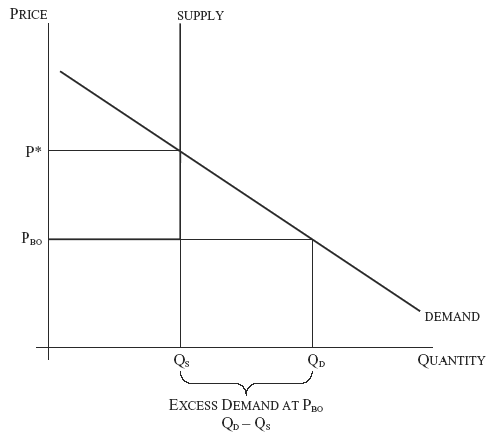
Because the box office often times price their tickets too low at PBO, whereas the market-clearing price is at P*. And therefore, there is an excess demand of tickets, which effects a secondary market.
These ticket resellers purchase a lot of the tickets at the low box office price and then meet the demands of those purchasers willing to pay higher prices for those same tickets.
Maybe this is why resale price maintenance exist, to erase ticket scalpers like us.
Spending Habits
This past week I happened to turn 20 years old (1 more year! =)). For a birthday present my mom decided to take me to Easton for a little shopping trip. Most people would think that going to Easton you would be able to find something worth buying. However after looking for about 2 hours my mother and I were left with nothing.
You would think that with our slowly crumbling economy that producers would want to benefit from the small amount of shoppers willing to buy something. Yet everything I saw looked like someone had barfed on a t-shirt and put a one hundred dollar price tag on it. It also seemed like stores were using the cheapest quality of fabric to make a fifty dollar t-shirt.
If producers really want to try to earn some money in this recession why not try making something that people would actually consider buying. Speaking for myself I would pay more for a quality made product that I would wear instead of getting something cheap and only wear once. I just wish that producers would conform to consumers needs in this economic crisis. For those that are willing to spend some cash, why not give them a good product. Word of mouth would therefore give producers more customers and also give them some profit. Yes, nowadays you are going to have to pay more for quality but in my mind that is better than getting a piece of crap that you can’t wear more than three times. Well since my mother and I were unable to find anything we decided to get pedicures. It sucks that producers missed out on some willing to spend money from Kath (mom).
You would think that with our slowly crumbling economy that producers would want to benefit from the small amount of shoppers willing to buy something. Yet everything I saw looked like someone had barfed on a t-shirt and put a one hundred dollar price tag on it. It also seemed like stores were using the cheapest quality of fabric to make a fifty dollar t-shirt.
If producers really want to try to earn some money in this recession why not try making something that people would actually consider buying. Speaking for myself I would pay more for a quality made product that I would wear instead of getting something cheap and only wear once. I just wish that producers would conform to consumers needs in this economic crisis. For those that are willing to spend some cash, why not give them a good product. Word of mouth would therefore give producers more customers and also give them some profit. Yes, nowadays you are going to have to pay more for quality but in my mind that is better than getting a piece of crap that you can’t wear more than three times. Well since my mother and I were unable to find anything we decided to get pedicures. It sucks that producers missed out on some willing to spend money from Kath (mom).
Coffee House Drama
I would assume to say that Starbucks is a growing, wide spread phenom, in a market where a variety of stores are trying to compete. I am no one to stop the drinking of coffee, since it is my morning boost, but why only Starbucks? It is funny how there are many different coffee houses around town, ranging from Panera, Caribou, Tim Hortons, McDonalds (i have my suspicions), Brennen's and even more local shops that no one really knows except the townies; my question is why only Starbucks? i have done my research and to make a cup of coffee costs about 23 cents and better yet to make those special lattes costs no more than 70 cents, yet we, as consumers, continue to pay the increasing price of $1.85 for a medium cup of coffee and upwards of $3 for a certain latte. The question that arises in my head is why? Clearly they are trying to make a profit, and that is respectable, but than why only Starbucks? I can say that i will occasionally have Starbucks coffee, but by no means is it my "home away from home" like it is for many people. I would venture to say that although there are MANY firms and competing coffee houses everywhere, Starbucks acts as a monopolistic firm. They control, for the most part, what the market does in the area of coffee. There stronghold on this market is really insane, YET they still are having economic issues, like many other stores.
I Hate the New York Yankees
Spring is almost here and that means it is baseball season. That also means it’s time to renew my hatred for the New York Yankees. I don’t hate the Yankees just because they always win and their obnoxious, bandwagon riding fans, I hate them for how they win and in doing so they are ruining baseball.
You’re probably wondering what this has to do with economics, so I’ll get right to it. The Yankees, as Major League Baseball’s most popular team, bring in the most revenue through ticket sales, merchandise sales, television contracts and so on. This high demand to see their games and buy their apparel allows them to raise prices and bring in higher revenue then all of the other 29 teams in baseball. Last year the Yankees had a disappointing season and seeing the Tampa Bay Rays make the World Series apparently caused the Yankees to get so enraged that they needed to spend money like never before this off-season. This is why I hate the Yankees; they spent 441 million in total contracts, while the other 13 American League teams spent 176 million combined. The Yankees have a monopoly on the best players available to sign. Other teams cannot compete with the money the Yankees have to give to the best players. So when a really good player’s contract is up with a small market team like the Indians or Reds, they decide to not re-sign, instead opting to get paid outrageously by the Yankees. One could argue that the New York Mets and Boston Red Sox can spend as much the Yankees, making it an oligopoly instead of a monopoly, but none of those teams spent money like the Yankees did this off-season.
My solution is that Major League Baseball should impose a salary cap, in other words, a ceiling on the amount of money a team can spend on its players. All of the revenue brought in by teams would be shared equally by the teams. Additionally, baseball should introduce a price floor, a minimum amount of money a team can spend on a roster. Last year the Yankees spent 207 million on their roster, while the Florida Marlins spent 22 million on their team. Alex Rodriguez made more money last year than the entire Marlins team. As a Reds fan and a fan of baseball I’m sick of seeing all of the best players leave their former teams for the Yankees.
You’re probably wondering what this has to do with economics, so I’ll get right to it. The Yankees, as Major League Baseball’s most popular team, bring in the most revenue through ticket sales, merchandise sales, television contracts and so on. This high demand to see their games and buy their apparel allows them to raise prices and bring in higher revenue then all of the other 29 teams in baseball. Last year the Yankees had a disappointing season and seeing the Tampa Bay Rays make the World Series apparently caused the Yankees to get so enraged that they needed to spend money like never before this off-season. This is why I hate the Yankees; they spent 441 million in total contracts, while the other 13 American League teams spent 176 million combined. The Yankees have a monopoly on the best players available to sign. Other teams cannot compete with the money the Yankees have to give to the best players. So when a really good player’s contract is up with a small market team like the Indians or Reds, they decide to not re-sign, instead opting to get paid outrageously by the Yankees. One could argue that the New York Mets and Boston Red Sox can spend as much the Yankees, making it an oligopoly instead of a monopoly, but none of those teams spent money like the Yankees did this off-season.
My solution is that Major League Baseball should impose a salary cap, in other words, a ceiling on the amount of money a team can spend on its players. All of the revenue brought in by teams would be shared equally by the teams. Additionally, baseball should introduce a price floor, a minimum amount of money a team can spend on a roster. Last year the Yankees spent 207 million on their roster, while the Florida Marlins spent 22 million on their team. Alex Rodriguez made more money last year than the entire Marlins team. As a Reds fan and a fan of baseball I’m sick of seeing all of the best players leave their former teams for the Yankees.
Saturday, March 7, 2009
Chipotle
I decided to blog about one of my favorite meals, the Chipotle burrito. I almost always get the same thing; rice, no beans, half barbaco half steak, mild, hot, corn salsa, sour cream and cheese. I will deviate from this occasionally by getting fajita vegetables, pinto beans, or inserting chicken for one of the meats, it depends on what mood im in really. There are a number of things that bug me at Chipotle; here are my main pet peeves. The biggest would have to be the look that you get when you ask, "can i some more ______ on my burrito/tacos/bowl?" I usually don't get beans or the fajita veggies, so in this case I always ask for extra rice. I also ask for lots of the corn salsa (love that stuff). For the most part I will always the same look up from my burrito they are making that says, "Really? You want some more, like this burrito isn't big enough??" So the employee will add a tid-bit extra, and move on ignoring the pissed off/roll of the eyes I give them. I do understand their employer probably tells them under no circumstances should they give a customer more then the alloted spoon-full. This measurement I'm guessing has already been decided by the firm as the "serving size" or amount needed for one unit. All the ingredients are imput costs to the firm and every time a worker puts more then this measurement into a burrito, the firm is essentially losing money.
I was disappointed when they raised prices on their entire menu. I began thinking of reasons, and two came to mind. One, perhaps some of the ingredients (imput costs) have increased, forcing Chipotle to raise the overall price. This makes the most sense, and sure enough, by simply Googling, "Chipotle raise price" you get an article that details the rising cost of beef and chicken. Two, by raising the price they are simply trying to get a larger profit. What's a 20-30 cent raise in their prices going to do to the number of customers? Practically nothing, I mean common, those burritos are like crack to college students, and their willingness to pay is not going to change. I on the other hand, decided to see what other substitutes where out there on the market, ready to be eaten. I live off 12th a little past indianola, so Chiptole is extremely close, and I pass by it just about every day. I also walk by Phat Wraps, a little known food joint that offers a close substitute to Chipotle. This place is awesome, if you have never tried it you should probably check it out. Here you have the option of chicken, steak, or vegetarian, but the glitch is that you yourself can add as many veggies to your wrap as you want. I tend to make my wrap as PHAT as possible, so it can almost be as large as the burrito you get at Chipotle. One other substitute that comes to mind can be purchased at United Dairy Farmers. I only mention this product because it is both a burrito, and kind of large. I am talking about the BOMB Burrito, a massive mess that you microwave. I highly suggest that you never try to eat one of these in any state, whether your sober,famished, or wasted, because you will forever regret the decision.
Rising Tuition For Non-Residency Student
Throughout this economics class I have begun to actually understand why our nation functions the way it does and then I realized it is not as easy as I thought to fix problems within the United States, or the whole world for that matter. When I started this class I did not really see how economics fit into my life because, as most college students are, I was more consumed with how things directly affected me, instead of looking at the big picture. Once this quarter began I realized one huge issue that affects my daily life and the money choices I must constantly be aware of. I am an out-of-state student who is from Florida. I always wanted to go out of state to lead me in becoming a more independent individual. I was always a big fan of Ohio State, which happens to be one of the more expensive out-of-state tuition costs. My family is middle class, so the tuition can be very expensive for us. With that being said, I feel that a price ceiling should be put on college tuition.
Before this class I understood and knew more about a price floor, especially in dealing with a person’s wage. In this class I have learned that a price ceiling is a capped amount on what something should cost. A price ceiling on tuition would be dramatically help me, but also any student struggling to pay for school. Out-of-state tuition is way over double what a resident pays. I ended up having to attend a community college last year, in order to be able to afford Ohio State's non-residency tuition, which does not seem right. With a price ceiling on tuition, more students would decide to attend college out of state, allowing them to experience more and try new things. I understand and recognize that students from out of state should have to pay more, but I feel the amount is unfair and should be monitored more. On the opposite side though, I realize that if a price ceiling was incorporated, we may be trying to control the economy too much. From different videos we watched about other countries in the past (Russia, ect.) and other things we learned about, that can be hard on every individual in the long run because the economy must somewhat function/flow on its own.
This has also led me to understand why things within out country are priced they way they are. Even costs of things, including tuition, rent, clothes, and more are effected by elasticity/ inelasticity. The more substitutes there are for an item causes the price to be more affordable. That connects back to tuition. If people want to attend The Ohio State University, such as myself, they are willing to pay that cost because there is only one OSU and no exact substitute to that. Hopefully as the economy begins to turn around, tuition costs will begin to lower.
Before this class I understood and knew more about a price floor, especially in dealing with a person’s wage. In this class I have learned that a price ceiling is a capped amount on what something should cost. A price ceiling on tuition would be dramatically help me, but also any student struggling to pay for school. Out-of-state tuition is way over double what a resident pays. I ended up having to attend a community college last year, in order to be able to afford Ohio State's non-residency tuition, which does not seem right. With a price ceiling on tuition, more students would decide to attend college out of state, allowing them to experience more and try new things. I understand and recognize that students from out of state should have to pay more, but I feel the amount is unfair and should be monitored more. On the opposite side though, I realize that if a price ceiling was incorporated, we may be trying to control the economy too much. From different videos we watched about other countries in the past (Russia, ect.) and other things we learned about, that can be hard on every individual in the long run because the economy must somewhat function/flow on its own.
This has also led me to understand why things within out country are priced they way they are. Even costs of things, including tuition, rent, clothes, and more are effected by elasticity/ inelasticity. The more substitutes there are for an item causes the price to be more affordable. That connects back to tuition. If people want to attend The Ohio State University, such as myself, they are willing to pay that cost because there is only one OSU and no exact substitute to that. Hopefully as the economy begins to turn around, tuition costs will begin to lower.
Friday, March 6, 2009
Supply and Demand on the Econ 200 Blog
As I read Professor Hampton's latest email pleading for posts from those of us who procrastinate, I discovered some underlying principles of economics at work. It may seem like a strange thing to find in an email about blog posts and grades and slackers, but economics was there (haunting me). The good I will be focusing on in this discussion is blog posts, and the currency is points. Of course, this system will not exactly match that of a true market economy, because the goods are being paid for by a single person, but there are still some surprising parallels.
The first point of discussion will be supply and demand. Professor Hampton said that there will no longer be any points given for posts referring to opportunity cost because too many have already been written (I would place a direct quote here, but I already deleted the message because the opportunity cost of keeping it in my overflowing OSU email account was obviously too high...but enough wasting time with things that won't get me points...and no, I'm not bitter because I had an awesome opportunity cost post lined up about my favorite Golden Girls episode). This depreciation of opportunity-cost-centered post value shows a direct correlation to the economic principle that, as supply rises, quantity demanded decreases. This decrease in quantity demanded is directly related to a decrease in cost of the good in question, opportunity cost posts, as related by the demand curve.
This leads directly into a discussion of price-elasticity of demand. The only type of post named by Professor Hampton as one that would not receive points is an opportunity cost post. Though we lack the evidence to presume that opportunity cost posts are more elastic than other types (it may just be that the high supply has been the sole cause of the decrease in value), we can certainly make the claim that such post have an elastic demand curve. This is a reasonable assumption because a reasonably large change in demand was witnessed as a result of a change in supply.
Thus the principles of microeconomics are at work in the most unlikely of places: economics class. Er...well, maybe it is the most likely of places. Anyway, they are certainly visible in the exchange of goods taking place on the Econ 200 blog.
Now, it's time for me to find out what Dorothy, Blanche, and Rose are going to do about that Latin boxer that Sophia bought with their money....
Game Theory, Nash Equilibrium, and Grinders
There is a sandwich shop on campus that sells open-faced toasted subs. At this restaurant there are four managers who participate in a kind of iterated prisoners dilemma, though I'll try to show how each kind of game theory exercise we worked in class can build a model of this scenario.
More about the situation: Since, no manager started working in the store when it opened for business, each of these four players joined a game already in progress. They work in a regular round robin rotation, that is, manager 1 works the first shift; manager 2 works the second shift, and so on with manager 1 coming back in to work the fifth shift, etc. Due to a hilarious love square between these managers none of them communicate outside of work or during shift changes. Finally, each manager really needs to keep her job so they will do whatever a customer asks; they are fully willing to do the the amount of work required to serve all the customers and this alone will prevent termination.
Let's assume Monday morning manager 1 (M1) walks into the store and starts to get things ready. M1 finds that there are some things that are not done that should be done. Now, M1 has a decision to make, either she can work feverishly to get all the things done that need to be done or she can choose to do the least amount of work required to serve the customers and no more. That is, she can serve all the guests but refuse to restock or prepare food for potential need in the next shift. She decides to choose the latter. M2 works that night and finds many things undone and has the choice laid before M1 that morning. Suppose, she chooses the latter on the basis of a tit-for-tat strategy, and suppose M1 did as well. M3, same outcome. When M4 comes into the shift she chooses the second option again but on the basis that she has been burned once, and from now on will never cooperate (Nuclear option).
This complicated real world case highlights a couple of things. One kind game theoretic model for this game is that each manager knows that her dominate strategy for "gettin' paid" and doing the least amount of work is to do only what is required by the customer. This creates a Nash Equilibrium. It is in the best interest of each manager to do the least amount of work possible and none are given an incentive to change.
Another interesting perspective of this example is the following. In lab, when we played the group games with the common pot, it only took one person to remain a freeloader in the initial round, where everyone was naive enough to think everyone would put all their money in the pot, to cause others to defect as well (the round where the number of defectors was identified). One person's decision had a major impact on the rest of the players. That's the kind of impact that M4 has on the rest of the group. If we were to add one new manager each week with the tit-for-tat strategy but who initially chooses to cooperate, M4 will be able to change any consecutive choices to cooperate into a new trend to defect.
The working world is even more complicated than this example since there are consequences to not doing anything during a shift because a manager can complain to someone further up the authority chain, which is about the most obvious of options in a pool of extra complications. The models that we work on in class are extremely telling even while making a bunch of extra assumptions. Think about how much more money we each could have made in lab if we were able to talk to all the members of the group. On second thought, there's extra credit for being in some earnings percentile, I think people would have still chosen to defect since in the long run we are in competition. Interesting stuff!
More about the situation: Since, no manager started working in the store when it opened for business, each of these four players joined a game already in progress. They work in a regular round robin rotation, that is, manager 1 works the first shift; manager 2 works the second shift, and so on with manager 1 coming back in to work the fifth shift, etc. Due to a hilarious love square between these managers none of them communicate outside of work or during shift changes. Finally, each manager really needs to keep her job so they will do whatever a customer asks; they are fully willing to do the the amount of work required to serve all the customers and this alone will prevent termination.
Let's assume Monday morning manager 1 (M1) walks into the store and starts to get things ready. M1 finds that there are some things that are not done that should be done. Now, M1 has a decision to make, either she can work feverishly to get all the things done that need to be done or she can choose to do the least amount of work required to serve the customers and no more. That is, she can serve all the guests but refuse to restock or prepare food for potential need in the next shift. She decides to choose the latter. M2 works that night and finds many things undone and has the choice laid before M1 that morning. Suppose, she chooses the latter on the basis of a tit-for-tat strategy, and suppose M1 did as well. M3, same outcome. When M4 comes into the shift she chooses the second option again but on the basis that she has been burned once, and from now on will never cooperate (Nuclear option).
This complicated real world case highlights a couple of things. One kind game theoretic model for this game is that each manager knows that her dominate strategy for "gettin' paid" and doing the least amount of work is to do only what is required by the customer. This creates a Nash Equilibrium. It is in the best interest of each manager to do the least amount of work possible and none are given an incentive to change.
Another interesting perspective of this example is the following. In lab, when we played the group games with the common pot, it only took one person to remain a freeloader in the initial round, where everyone was naive enough to think everyone would put all their money in the pot, to cause others to defect as well (the round where the number of defectors was identified). One person's decision had a major impact on the rest of the players. That's the kind of impact that M4 has on the rest of the group. If we were to add one new manager each week with the tit-for-tat strategy but who initially chooses to cooperate, M4 will be able to change any consecutive choices to cooperate into a new trend to defect.
The working world is even more complicated than this example since there are consequences to not doing anything during a shift because a manager can complain to someone further up the authority chain, which is about the most obvious of options in a pool of extra complications. The models that we work on in class are extremely telling even while making a bunch of extra assumptions. Think about how much more money we each could have made in lab if we were able to talk to all the members of the group. On second thought, there's extra credit for being in some earnings percentile, I think people would have still chosen to defect since in the long run we are in competition. Interesting stuff!
The production possibilities frontier is a graph that shows the combination of output that the economy can possibly produce given the available factors of production and the available production technology. Since I’m a sports fan, I’ll use basketball as my example of this. An owner of an NBA team can have a max of 25 players on his roster or a max of 20 coaches on his team. An example of efficient production would be any combination of players and coaches that falls on the production possibilities frontier line even if it means using all 25 of players or all 20 spots of coaches. It probably wouldn’t be a good idea to use all the spots on coaches but it would still be classified as an efficient output according to the Production Possibilities Frontier. An inefficient production example would be any combination of players and coaches that falls in the area inside the PPF line. An example of this would be if he had only 10 players and 5 coaches on the roster. The last type of production I’ll give an example of is impossible production. Production is impossible if it falls outside the PPF lines. That means that if this owner tried to have 20 players and 20 coaches on his roster, he would be demonstrating impossible production on the production possibilities frontier. I would guess that the success of an NBA team would depend on how they utilize their options on the PPF.
Game Theory?
A few weeks ago when I was at a party on campus, the party just so happened to be running out of "soda." My friend and also owner of the house quickly began taking up a collection to buy some new soda. He was having a rough time getting people to donate to the pot so he thought it was a good idea to put a twenty dollar bill in the large, clear, glass cup. I asked him what is the point in doing that? I thought that if everyone sees the twenty dollar bill in there, then they will feel as if we have gathered enough money to make another soda run. However, he claimed that if people saw the twenty dollar bill in there then they would be willing or at least feel as if they could pay up with some cash. It did not really make too much sense to me at the time. A few days back when we had the extra credit assignment in Arps Hall, the game in which people could add to the group pot even though it was in their best interest to keep the money for themselves reminded me of this situation. The people at the party played as the students who could add to the pot or be a bunch of jerks and keep their money. As the game showed, people added to the pot when they could see what the maximum contribution was. My friend's idea worked as people added to the pot at the party. In one game that we did in Arps, once money was added to the pot their was no way of getting it back. This game also reminded me of the party because once people added to the pot their was no way they were getting their money back! I am not really sure what this theory is called, maybe Game Theory, sorry Kyle, but I do like it since it is a easily carries over into my real life just about every weekend.
More Economics in High School/College Curriculum
With the current economic situation that the world is in, and the fact that the majority of Americans have absolutely no clue how the economy works or how to fix it, shouldn’t we be required to learn just a little bit more about how our economic system works. A person could be extremely smart and talented and go through their entire high school and college career and take just one economics class for 18 weeks. (Assuming you are required to take one economics class) My major is Mechanical Engineering so I’m not required to take this class, it is an elective, but I am however, required to take various ethics courses throughout my college career. Is it just me or if we as 18-20 year olds do not know the difference between right and wrong at this point in our lives, are we ever going to know? This is my second economics course at Ohio State in addition to one I took in high school and I still get frustrated when I hear all these people talk about the economic crisis on TV and I have no idea what they are talking about.
This is why I think if we are ever going to have a country where the general population can make educated decisions about who they choose to lead them we need to actually become educated in things that matter currently. Which is why if we are to graduate from college we should have to take at least one, probably more economics classes so at least we can pretend like we know what the “experts” are talking about.
This is why I think if we are ever going to have a country where the general population can make educated decisions about who they choose to lead them we need to actually become educated in things that matter currently. Which is why if we are to graduate from college we should have to take at least one, probably more economics classes so at least we can pretend like we know what the “experts” are talking about.
Thursday, March 5, 2009
How elastic is soda? Are Coke and Pepsi really that different in taste? I don’t really think so. Whenever I go to the grocery store I buy whatever is cheaper. Sometimes, I don’t even buy Coke or Pepsi. I’ll buy Meijer or Kroger brand soda. Sure there are those devoted Coke only or Pepsi only drinkers. But I’m not willing to pay a couple extra dollars for a certain brand of soda when I think they both taste the same. Soda is elastic because there are numerous amounts of substitutes. But couldn’t we also say that it is inelastic because the difference in taste is really not all that different? It’s not a luxury, or at least in our country it isn’t. There are a lot of close substitutes. Prices may change a little bit but it’s not as though Coke costs $10 per can and Pepsi costs $1 per can. So, I think soda is inelastic. The quantity demanded of soda does not change dramatically based on how much it costs, whether it is Coke or Pepsi.
When a product is elastic, the availability of substitutes is high. Let's take for example North Face jackets. For the past couple of years the sales of North Face jackets has increased exponentially. With the high cost of the jackets, consumers looked for a way to increase their consumer surplus. After a couple of years, North Face knock-off jackets emerged and consumers realized how cheap they were and started buying them.
When I first heard about these jackets I immediately wanted one because they are so warm, comfortable, and fashionable. My mom is a big bargain shopper and she wouldn't let me spend over $100 on a black jacket. This year we were shopping at TJ Maxx (probably one of my favorite stores!) and I found a similar jacket for $20, but it didn't have the North Face label on it. This was an amazing bargain and I had to get it. Now, I have a warm, black jacket that is just as good as a North Face and I saved over $80!
The availability of substitutes for a North Face jacket increased therefore, North Face’s demand decreased and the demand for the knock off brand increased, making the knock-offs sales increase. Now everyone (except North Face Co.) is happy and warm.
When I first heard about these jackets I immediately wanted one because they are so warm, comfortable, and fashionable. My mom is a big bargain shopper and she wouldn't let me spend over $100 on a black jacket. This year we were shopping at TJ Maxx (probably one of my favorite stores!) and I found a similar jacket for $20, but it didn't have the North Face label on it. This was an amazing bargain and I had to get it. Now, I have a warm, black jacket that is just as good as a North Face and I saved over $80!
The availability of substitutes for a North Face jacket increased therefore, North Face’s demand decreased and the demand for the knock off brand increased, making the knock-offs sales increase. Now everyone (except North Face Co.) is happy and warm.
Wednesday, March 4, 2009
Underground Trade
This past week I was in an argument with friends about how well the theories of economics apply to underground trade, such as the resale of concert tickets, text books, and other goods and services traded without the government's knowledge. Most people seemed to think that in the unregulated world of underground trade economics couldn't predict anything about how the market would shift. My immediate response was “of course economics deals with underground trade. Economically speaking, underground trade is one of the few perfect markets remaining!”
The lack of regulation creates a perfect medium for the equilibrium of supply and demand of products to take place. Every scalper that walks around the Nationwide Arena is out for his own profit. Of course every one wants to make as much as possible, while people without tickets want to pay as little as possible. This leads to haggling and shopping around for the best price available. With no government regulations on the cost of scalped tickets, other than its questionable legality, the constant competition between suppliers and consumers keeps the price in check. In addition, if Ticketmaster has sold out for a show it is likely that the price of scalped tickets will be expensive and vice versa. Therefore the underground market is the final pure frontier for pure economics.
The lack of regulation creates a perfect medium for the equilibrium of supply and demand of products to take place. Every scalper that walks around the Nationwide Arena is out for his own profit. Of course every one wants to make as much as possible, while people without tickets want to pay as little as possible. This leads to haggling and shopping around for the best price available. With no government regulations on the cost of scalped tickets, other than its questionable legality, the constant competition between suppliers and consumers keeps the price in check. In addition, if Ticketmaster has sold out for a show it is likely that the price of scalped tickets will be expensive and vice versa. Therefore the underground market is the final pure frontier for pure economics.
Opportunity Cost, Again
So, a bunch of people are writing about opportunity costs. It turns out that opporunity cost calculus actually got me into economics (more evidence for the "economic brain"?). At the end of last spring quarter I realized that I was finished with a B.A. in philosophy, which caught me off gaurd because my goal was to take more classes regardless of my degree status so I could 1, delay my loan obligations, and 2, better prepare myself for graduate school.
Funny thing happened around August last year though as the financial market began to tank, and with it academic department endowments, student loan interest rates increased, student loan availability decreased, vast increases in the number of graduate school applicants, university hiring freezes, and unrelated to the market changes was my increasing lack of confidence that I really knew what I was doing in philosophy besides having a love for it. Since, I hadn't chosen to graduate in the spring I had a new option, I could add a major. I wasn't prepared to enter the job market as solely a philosophy major and my loans repayment was drawing nearer. I quickly turned to adding an economics major because it wouldn't require any more GEC's and it was business related. At this point I actually calculated my opportunity costs for adding an economics major, and separately calculated the costs for trying to join the job market in august.
Simultaneously, another economic concept was lurking. My decision about adding another major reflects marginal cost/benefit analysis. Adding another major cost me a full year and close to 10,000 in debt, but the benefit of adding one more major (more precisely, adding a business related major) was greater starting pay as well as greater ratio between starting and mid-career pay.
Simultaneously, another economic concept was lurking. My decision about adding another major reflects marginal cost/benefit analysis. Adding another major cost me a full year and close to 10,000 in debt, but the benefit of adding one more major (more precisely, adding a business related major) was greater starting pay as well as greater ratio between starting and mid-career pay.
I was recently working on an assignment with my biology lab partner. On our drive home, he mentioned that he was part of the Student Athletic Activities Board at Ohio State. I started to tune him out until he said “total revenue” and it sparked my interest. I was like “hey! I know what that is!” All of a sudden I was engaged in the conversation and I’m sure he thought I was crazy but we started discussing how the economy is impacting athletic events at OSU. Due to college students, and really the rest of the spectators, being even poorer than usual, the amount of total revenue brought in from athletic events has decreased. I told him this is because athletic events are highly elastic. There are many close substitutes for going to the games, such as watching the game on t.v. when it is televised, or choosing an alternate way to spend one’s time. When I was at the hockey game this past weekend, I realized that there was a surplus of tickets; a lot of the seats in the arena were empty. My lab partner and I discussed that if prices were lowered to accommodate the spectators willingness to pay, Ohio State might be able to bring in more revenue. This is because if the price is lowered it would be closer to the equilibrium price and essentially at the equilibrium price, a ticket would be sold for every seat in the arena. Then our discussion turned to opportunity cost, a student could go to a hockey game for $6, pay for a hot dog that costs around $4, and a drink that costs approximately $3.50. So in total the Total Cost for going to a hockey game for two people is $37. However, staying in and watching the game on your own t.v. and splitting a case of Natty Light for two people has a Total Cost of $12. But, then we considered “implicit costs” for attending the game. These include the school spirit and encouragement to the players and putting money into your school that could potentially end up benefiting yourself. So, thank goodness that my biology lab partner was willing to take away time from biology and engage in a conversation of economics that allowed me to apply everything Kyle has taught me!
Opportunity Cost and the Infamous Buck Yuck
Yesterday as i was waiting in line at the infamous Buckeye Express, better know as "Buck Yuck", a few thoughts crossed my mind. The first thought that came to my mind was, "why did i decide to go to Buck Yuck when i had so many other options?" There is a reason that the Buckeye Express earned the name Buck Yuck and honestly it;s because the food there is basically disgusting. The next question I asked myself was, "why is the line so long?" Why would so many people decide to go to Buck Yuck when they too have better options? After pondering this for a while I came to an epiphany, and all of my questions were answered in one economic term. Opportunity cost. During fall quarter when the weather was warmer i never went to the Buck Yuck. Instead i would walk over to Market Place or Mirror Lake Cafe for some food of higher quality. At that time the opportunity cost, a five to ten minute walk, did not exceed the price i would have to pay by eating a disgusting meal from Buck Yuck. For some people however, for example someone on crutches, the opportunity cost of a five to ten minute walk is much higher. For this reason alone, the Buck Yuck was not completely abandoned during fall quarter. this quarter, however, i find myself going to the Buck Yuck almost every day. I absolutely despise cold weather and I usually avoid it at all costs, even if that cost is eating disgusting Buck Yuck Food. The cold weather is an external factor and therefore it effects increased everyones opportunity cost of a five to ten minute walk, and for people like me it increases so much that it is no longer worth the benefit of a delicious meal. These people were the reason that the line I was waiting in was so long.
The First Three Principles of Economics Applied to the OSU Women’s Gymnastics Team:
Principle 1: People Face Trade Offs
In gymnastics there are four events: vault, bars, beam and floor. When competing in the club level below college gymnastics, the gymnast competes every event and their goal is personal success. If they have a weak event it hurts their combined total score. Once you get to the college level, the goal is for the team to succeed. This means that whoever is the strongest on an event will be chosen to put up a score for that event. In this way, the most efficient at producing a routine on an event will contribute to the total there, while the most efficient at producing a routine on another event will contribute there. This allows us as a team to be producing at the most efficient point on the production possibilities frontier.
Principle 2: The Cost of Something Is What You Give Up to Get It
Because training is so critical, an athlete has many opportunity costs. My training overrules any other commitments I may desire to participate in. During the twenty hours dedicated to practicing in the gym I am trading off hours that I would use to be studying for economics, writing extra blogs, retaking aplia homework quizzes, writing out all my econ notes again, and reading ahead in our economics book. Instead of spending quality time at office hours, I must be on a bus traveling to competition sites across the country or making appearances at an assortment of sporting events to promote our next home competition (which everyone who reads this I encourage to come and enjoy an evening of competitive excitement on April 4th when we will be hosting Regionals right here at home in our very own St. John Arena at 7 PM).
Principle 3: Rational People Think at the Margin
For most athletes, more numbers and repetitions means greater amount of stress put on their body. At this point of a gymnastics career, there are about 18-20 years of pounding already put in. The problems that college coaches now face are marginal benefits and costs. As the number of repetitions increase, the marginal benefit of each product is the increase in the quality of each product. However, as the numbers increase, the marginal cost is the increase in the amount of wear and tear. Stress fractures, pulled muscles, and strained ligaments come into the equation. Thus, the coach must be able to determine the point at which marginal cost equals marginal benefit and operate at a level just below that point. If they operate at the point where the total cost of pounding is greater than the total revenue created from the increased level of production, the firm (athlete) will not be able to sustain for all their years of eligibility. The firm will close in the long run.
Tuesday, March 3, 2009
Best Buy messed up
In an effort to keep making profits like all businesses should do, Best Buy tried to outsmart their competition by paying as little as possible for some of the products they sell – in the case I am going to talk about, namely computer parts. However in their attempt to drown out rivals like Circuit City and Radioshack (which they’re doing a great job at), Best Buy became too greedy and it cost them 31 million dollars. Like most business firms, Best Buy received several bids from different companies that make these computer parts to buy from them. Basically these companies are setting a price they are willing to make and sell the computer parts, a price where their opportunity cost is at least equal to the income they will receive from the sale. It is much like the supply and demand curve that we see in class where some firms can afford to produce at a much lower cost than others, and so have to charge less to make the same profit as a company that has a higher cost. Well like any profit seeking company, Best Buy accepted the bid from the lowest bidder, much like the government does, except in this case it ended up costing them a huge sum of money.
The computer parts being sold to Best Buy came from a company called Chip Factory, who offered them up at shockingly low prices, which Best Buy eagerly accepted, but then managed to actually sell the parts at a much higher price. In one such case, Chip Factory won a bid for 20 computer parts at forty-two dollars per part, but ended up selling them for 571 dollars per part – obviously a huge increase. How was Best Buy not aware that they were being taken for a ride? The reason for this is that Chip Factory was bribing a man inside the company that managed to steer away any questions and suspicions. But the huge juggernaut that Best Buy is, someone should have seen the error. With the next highest bid for the contract in this case being seventy one dollars, someone should have asked how a company could make money at that low price, especially when no other company was willing to sell for less than seventy dollars per piece. Chip Factory could not have possibly been producing the computer parts at prices almost thirty dollars below the next cheapest firm. Not only that, but Best Buy’s accountants should have seen exorbitant amounts of money being charged for the contract. In a move to benefit the majority of people by allowing Best Buy to make a larger profit, sell products to consumers at a cheaper price, and make sure the company that was best at making these parts stayed in business, Best Buy managed to do almost the exact opposite by losing millions of dollars, which is inevitably going to be assessed to customers, and keeping money out of the hands of the firm that had the lowest opportunity cost for making certain computer parts. Schemes like these benefit no one except the criminal, and no one if the criminal is caught. Granted 31 million may have a relatively small impact on the economy as a whole, but in a recession like this, it never helps.
The computer parts being sold to Best Buy came from a company called Chip Factory, who offered them up at shockingly low prices, which Best Buy eagerly accepted, but then managed to actually sell the parts at a much higher price. In one such case, Chip Factory won a bid for 20 computer parts at forty-two dollars per part, but ended up selling them for 571 dollars per part – obviously a huge increase. How was Best Buy not aware that they were being taken for a ride? The reason for this is that Chip Factory was bribing a man inside the company that managed to steer away any questions and suspicions. But the huge juggernaut that Best Buy is, someone should have seen the error. With the next highest bid for the contract in this case being seventy one dollars, someone should have asked how a company could make money at that low price, especially when no other company was willing to sell for less than seventy dollars per piece. Chip Factory could not have possibly been producing the computer parts at prices almost thirty dollars below the next cheapest firm. Not only that, but Best Buy’s accountants should have seen exorbitant amounts of money being charged for the contract. In a move to benefit the majority of people by allowing Best Buy to make a larger profit, sell products to consumers at a cheaper price, and make sure the company that was best at making these parts stayed in business, Best Buy managed to do almost the exact opposite by losing millions of dollars, which is inevitably going to be assessed to customers, and keeping money out of the hands of the firm that had the lowest opportunity cost for making certain computer parts. Schemes like these benefit no one except the criminal, and no one if the criminal is caught. Granted 31 million may have a relatively small impact on the economy as a whole, but in a recession like this, it never helps.
Thinking about Econ 200 at work!
The concepts cover in our economics class are not just something we have to learn for school it is something we have to learn to be able to understand the world around us. I know at first I struggled attempting to learn the principles covered in lecture, until I realized it was much easier to apply these concepts to my life. I currently work in retail as a sales associate for Victoria’s Secret. And yeah I know you are all thinking how am I going to tie economics into a company that mainly just promotes half naked girls, but it actually has a huge affect on the company. Victoria’s Secret however, has way more to offer than the nude models in their ads. The company is owned by The Limited Brands Inc, and just so happens to be the number one selling Lingerie Company. Although like all other retail the company is struggling to make a profit because of the economy right now.
Everyday at work I have to review the sales plan to see how many bras must be sold every hour. If we are unable to accomplish the number projected for sales, then our store is unable to make sales plan for the day. This is due to the fact that bra sales are 50% of the sales plan for a day. If we can’t make the sales plan it dramatically affects our ability to be able to make plan for the week or even month. And yeah it doesn’t sound that bad because everyone is thinking well it’s still a number one company and it’s still always busy. However, that is only because the company does make bra sales plan most of the time and because the company has expanded its product to allow for a bigger consumer market. By offering more products for different age groups it allows for the company to carry multiple lines which brings consumers in which allows us to then expand the sale.
Victoria’s Secret has decided to make a few changes to help keep the company going strong. They have introduced coupons which offer a free product with a purchase and also have added more benefits to their store credit card to attempt to get consumer loyalty. If the company can build an even bigger consumer base it will help raise sales as well. The increase in profit will also help to allow the company to employ more associates who can help cut down on theft and that too will help increase the profit. All of these things are tactics which the company is doing to help ensure they make a profit and not let the economy bring them down. So I use economics daily when seeing how much I have to do in sales to help my company make plan. It’s all about supply and demand when it comes to selling bras.
Everyday at work I have to review the sales plan to see how many bras must be sold every hour. If we are unable to accomplish the number projected for sales, then our store is unable to make sales plan for the day. This is due to the fact that bra sales are 50% of the sales plan for a day. If we can’t make the sales plan it dramatically affects our ability to be able to make plan for the week or even month. And yeah it doesn’t sound that bad because everyone is thinking well it’s still a number one company and it’s still always busy. However, that is only because the company does make bra sales plan most of the time and because the company has expanded its product to allow for a bigger consumer market. By offering more products for different age groups it allows for the company to carry multiple lines which brings consumers in which allows us to then expand the sale.
Victoria’s Secret has decided to make a few changes to help keep the company going strong. They have introduced coupons which offer a free product with a purchase and also have added more benefits to their store credit card to attempt to get consumer loyalty. If the company can build an even bigger consumer base it will help raise sales as well. The increase in profit will also help to allow the company to employ more associates who can help cut down on theft and that too will help increase the profit. All of these things are tactics which the company is doing to help ensure they make a profit and not let the economy bring them down. So I use economics daily when seeing how much I have to do in sales to help my company make plan. It’s all about supply and demand when it comes to selling bras.
Even in College My Mom Helps with Homework
Well I've been thinking about what to post on this blog for a couple weeks now, and I'm going to go ahead and give it my best shot. I figured I would talk about what I understood most from Econ 200: Opportunity Costs.
Back in July of 2008 my mom had to make a big decision, which of course means opportunity costs were involved. One day my mom came to me and told me she was thinking about going to Atlanta to participate in a 3-day walk to raise awareness on breast cancer. This walk would take place in late October. My grandma on my mom's side was a survivor of breast cancer and my aunt on my moms side had passed away from breast cancer in May of 2008, so my mom was a pretty big advocate of breast cancer awareness. Anyway, my mom was getting all excited about how she was going to raise $2,200 to donate to breast cancer awareness so that she could walk in October. A friend of hers from when she was growing up had a mother who passed away from breast cancer when they were kids so she was going to try and get her to walk with her too. She couldn't wait to see her. When my mom reached her most excited state, my brother walked in the door from his 2-a-day football practice. He came to my mom and I and told us that he had been informed from his high school football coach that even though he was a sophomore he would be the starting center for the varsity team in the fall. At first my mom forgot all about her 3-day walk and hugged my brother and such. Doing the typical "I'm so proud of you" speech that every mother loves to give even though we don't care to hear it. Once she settled down a bit I got the chance to tell Tim (my brother) that I would make my best effort to come home for his game against Centerville High School, which was always our biggest rival despite getting beat by them ever since I can remember. When I made this statement my mom's euphoric state quickly went away. She immediately started going through the calendar of the athletic events at my high school to find the date of that Centerville game. I'm sure you all see where this is heading. Sure enough Tim played Centerville during one of the days that my mom would be in Atlanta if she chose to do her 3-day walk.
Now is where the opportunity costs set in. If my mom decides to go to Atlanta she will miss my brothers most important game of the season. She will also miss me taking a trip home from college, which is a fairly rare occurance. Since leaving for college she has seemed to like me much more, and loves every minute she gets to spend with me when I come home. It's weird how much she wants to hang out these days.
Pros to Walking:
-Raising $2,200 for Breast Cancer
-Self satisfying feeling that she has done her part
-Receives praise from friends and family for taking the initiative to get my family on board with breast cancer awareness
-Saves money that she would have spent taking me out to dinner while i was home
-Gets to see her childhood friend for first time in a long time
Costs of Walking:
-Misses my brother's first ever Centerville game
-Upsets my brother because she never missed a single soccer game of mine for all four years
-Misses me making my once-a-quarter trip home
-Cost of a round trip plane ticket to Atlanta
After weighing all of her options, she made the decision to go to Atlanta and walk for a cause she believed in. After raising $2,200 she boarded a plane in October and walked 60 miles in the rain wearing pink, carrying signs, and enjoying every minute of it. She also got her friend on board with the idea, so she had a fun time seeing her. Her decision was definitely a good one because my brother's team got destroyed, and I was only home for the 2 hours that my brother was playing.
My mom enjoyed her experience so much that she has already begun raising money for the 3-day walk next October in San Diego. She has also gotten her sister to join her this year.
Back in July of 2008 my mom had to make a big decision, which of course means opportunity costs were involved. One day my mom came to me and told me she was thinking about going to Atlanta to participate in a 3-day walk to raise awareness on breast cancer. This walk would take place in late October. My grandma on my mom's side was a survivor of breast cancer and my aunt on my moms side had passed away from breast cancer in May of 2008, so my mom was a pretty big advocate of breast cancer awareness. Anyway, my mom was getting all excited about how she was going to raise $2,200 to donate to breast cancer awareness so that she could walk in October. A friend of hers from when she was growing up had a mother who passed away from breast cancer when they were kids so she was going to try and get her to walk with her too. She couldn't wait to see her. When my mom reached her most excited state, my brother walked in the door from his 2-a-day football practice. He came to my mom and I and told us that he had been informed from his high school football coach that even though he was a sophomore he would be the starting center for the varsity team in the fall. At first my mom forgot all about her 3-day walk and hugged my brother and such. Doing the typical "I'm so proud of you" speech that every mother loves to give even though we don't care to hear it. Once she settled down a bit I got the chance to tell Tim (my brother) that I would make my best effort to come home for his game against Centerville High School, which was always our biggest rival despite getting beat by them ever since I can remember. When I made this statement my mom's euphoric state quickly went away. She immediately started going through the calendar of the athletic events at my high school to find the date of that Centerville game. I'm sure you all see where this is heading. Sure enough Tim played Centerville during one of the days that my mom would be in Atlanta if she chose to do her 3-day walk.
Now is where the opportunity costs set in. If my mom decides to go to Atlanta she will miss my brothers most important game of the season. She will also miss me taking a trip home from college, which is a fairly rare occurance. Since leaving for college she has seemed to like me much more, and loves every minute she gets to spend with me when I come home. It's weird how much she wants to hang out these days.
Pros to Walking:
-Raising $2,200 for Breast Cancer
-Self satisfying feeling that she has done her part
-Receives praise from friends and family for taking the initiative to get my family on board with breast cancer awareness
-Saves money that she would have spent taking me out to dinner while i was home
-Gets to see her childhood friend for first time in a long time
Costs of Walking:
-Misses my brother's first ever Centerville game
-Upsets my brother because she never missed a single soccer game of mine for all four years
-Misses me making my once-a-quarter trip home
-Cost of a round trip plane ticket to Atlanta
After weighing all of her options, she made the decision to go to Atlanta and walk for a cause she believed in. After raising $2,200 she boarded a plane in October and walked 60 miles in the rain wearing pink, carrying signs, and enjoying every minute of it. She also got her friend on board with the idea, so she had a fun time seeing her. Her decision was definitely a good one because my brother's team got destroyed, and I was only home for the 2 hours that my brother was playing.
My mom enjoyed her experience so much that she has already begun raising money for the 3-day walk next October in San Diego. She has also gotten her sister to join her this year.
Monday, March 2, 2009
Elasticity and Income
Lately I have really been noticing the effects of the economy on the lives of my family, friends, and boyfriend. Last month, my boyfriend sold his gas-guzzling F250 truck to buy a more fuel efficient Honda Civic. This was such a big chance in vehicles for him but he just got a five percent pay decrease at work so he is making the financial adjustments he needs. With a lower income, he can not afford to pay for the amount of gas that truck takes, but he is still willing to go out on dates with me and spend money at the theatre and at dinner. The F 250 truck is a luxury good for my boyfriend and therefore has an elastic demand to him whereas spending money on dates with me is inelastic. The truck also has a close substitute, the Civic, to switch to. The decrease in his pay drove him to purchase a near substitutes to make up for his losses. My boyfriend also has an opportunity cost in this case too though. His opportunity cost of still being able to spend money on dates or activities we do together is the cost of giving up his truck to settle for a vehicle of little importance to him.
Another issue I have seen recently in my family was the affects the economy took on my uncle when he got laid off from his job this year. He is the main source of income in the household and has two kids. He can collect unemployment for about 6 months but he had to start cutting back on many things. He used to shop at an expensive organic grocery and now he shops at a local supermarket and buys generic brand food. He has to use substitutes to cut back and save on money. For example, Cereal and toilet paper. He does not buy the expensive name brands of cereal like general mills or kelloggs anymore but instead substitutes for the generic brands and economy-size bags that contain more for less. With toilet paper he does not buy the soft, ultra thick brand name stuff but the cheap dollar store kind now. He also has to reduce his spending on luxury items like electronics, movies, and designer clothing. These things are not necessities like food. Food is inelastic because it is a necessity and even though there are cheaper substitutes, he will never completely cut food out of the spending budget. These are just a couple things I have noticed that have reminded me of econ class lately.
Personal Loans
This entire quarter I have been taking Business-Finance 220 and have noticed several economic principles presented throughout the course. Just recently we began discussing loans and the types of loans that are available and the different places one might receive a loan. Because of the credit crisis and recent recession it is more difficult than ever to receive a loan without a considerable credit score. I learned something I never knew before from this lecture, which is that even when loaning or borrowing money from an individual, such as a friend or relative, interest must be paid to the individual making the loan. It seems idiotic at first that you cannot borrow from a friend or relative without having to pay an interest rate. However, as our professor put it the person loaning the money must be compensated for their opportunity cost of possibly receiving a better return on their money elsewhere in the market, for example the stock market (probably not today though). The government even goes so far as to set the exact interest rate that must be charged by an individual providing the loans and my professor believed it to be right around 8.5%. The same is true for banks when providing loans or any institution charging interest. Interest that is earned must be payment for the loan provider because it must exceed their opportunity cost to invest their money elsewhere and get a possible better return in the market.
Sunday, March 1, 2009
The Textbook Sale/Resale Business
As all of us students have found out since our attendance at the University, there is a large scam that goes on in the area of textbook sale and resale, etc. There is a long cycle that a given textbook goes through, and it is filled with many variables. There is a definite supply and demand for each textbook that changes over time. We, as students, find out pretty quickly what the supply and demand curves look like for a book we need by going online and checking what kind of prices we can find the book for, as well as how many places we can find that have the book available.
The beginning of a books journey begins when it first enters the market in new condition. In some cases, when a book has just been released, the University Bookstore holds a monopoly over the sale of that book. The bookstore, like any other business-minded company, makes sure that there is a limited supply of the book in stock and charges ridiculously high prices to make a maximum profit. Since the demand for this book needs to be met, the consumers have nowhere else to buy the book and the Bookstore makes a killing.
However, there are ways in which the market for the book changes. For example, there could be close substitutes for this book such as a used version of the book or an older edition. The demand curve for the original new book is then shifted to the left and less books would be demanded at the same high price that the Bookstore was charging. Thanks to this, we often have a chance to search the internet to look for a substitute that would function just as well as the new book, but cost less.
Eventually, the new books that are sold in a given time period are used for a while and then become of little to no value to the owner. Also, the close substitutes for the book (used books) are of no value to their owners. So everything is basically bumped down a notch; the new books are worth what the used books were worth and the used books become worth even less.
This is a veritably endless cycle that is an integrated part of student life. As in any market, there are both buyers and sellers that will make out well and others that will get shafted in the sales for a given quarter. It is an interesting market to examine, and one could think about the subject for hours and just find him or herself going in circles since almost every book goes on a very similar journey. There are evident factors that change the supply and demand curves for the books in its various stages and it's fun to be able to connect what we have learned in our Econ 200 class to our college life.
Hard Work Pays Off
New technologies are developed everyday. As the internet and use of computers has become a more common use in big business, the market for paper has changed. Although some companies still need paper for advertising such as politicians and newspaper ads or coupons, many banks and credit card companies have started paperless statements that you can recieve via e-mail instead of "snail mail." This decrease in the amount of junk mail sent to homes and increase in the amount of spam e-mails has greatly affected my family. My dad works for a company that basically prints junk mail. The market has changed so drastically that a once thriving company is now unable to find work sometimes. The people working at the machines have become so efficient at what they do that many workers have been laid off. Some days my dad will come home early from work because his boss underestimated the amount of time a job would take, and there was no more work to be done. Over the past year may dad made 12 percent less than he did the previous year due to the fact that work was being done more efficiently and less people were in need to paper products. Along with have less work and efficient workers, the company has shutdown smaller plants around the US as the market conditions have dropped. At my dad's plant many workers have been laid off. My dad was fortunate enough to keep his job, but I found out later that he is being switched back and forth between different departments of his plant. He was on the list of possible lay-offs and the company decided to keep him. Aparently, as an efficient and hard worker, the people higher up in the company recognized the cost of keeping my dad on the pay roll. The opportunity cost of losing the drive and focus that my dad has when assigned any task was much higher than the actual cost of paying my dad to work.
I work for the Department of Natural Resources. As an intern there I heard a lot of talk about people losing their jobs and I asked my boss why she was still able to have 2 interns when the state was cutting back on spending. She told me that her interns were the most important thing to her. She is in charge of the new web page for the department and her time is filled withe meetings and constant work on the new design, getting it approved, changing little parts, finding pictures. As an intern I open surveys and record the data from the surverys. Over the summer thousands of surveys come in. If my boss had to read the surveys on top of all of her other work, she would have no time left in the day to even sleep. Although the actual cost of keeping at least 2 interns throughout the entire year is pretty costly, her opportunity cost of losing the extra help with tasks that are simple but take a lot of time was very high. I also fill requests and send out brochures to people all around the country with information on Ohio state parks. By sending out these brochures I am helping companies like my dad's to remain in business. Printing companies are dependent on the demand of printed materials. My job is dependent on the demand of brochures by consumers and the ability of materials to be printed. My dad's job is dependent on mine, and mine on his. As long as the interdependent relationships among all different types of jobs exists, along with constant supply and demand of different goods, the economy will have to make a turn for the better.
I work for the Department of Natural Resources. As an intern there I heard a lot of talk about people losing their jobs and I asked my boss why she was still able to have 2 interns when the state was cutting back on spending. She told me that her interns were the most important thing to her. She is in charge of the new web page for the department and her time is filled withe meetings and constant work on the new design, getting it approved, changing little parts, finding pictures. As an intern I open surveys and record the data from the surverys. Over the summer thousands of surveys come in. If my boss had to read the surveys on top of all of her other work, she would have no time left in the day to even sleep. Although the actual cost of keeping at least 2 interns throughout the entire year is pretty costly, her opportunity cost of losing the extra help with tasks that are simple but take a lot of time was very high. I also fill requests and send out brochures to people all around the country with information on Ohio state parks. By sending out these brochures I am helping companies like my dad's to remain in business. Printing companies are dependent on the demand of printed materials. My job is dependent on the demand of brochures by consumers and the ability of materials to be printed. My dad's job is dependent on mine, and mine on his. As long as the interdependent relationships among all different types of jobs exists, along with constant supply and demand of different goods, the economy will have to make a turn for the better.
Life with the economy as it is ....
In order to get some sort of steady income while going to school I tend to babysit on average 15 hours a week. With the economy as it is, I have noticed that many families are cutting back on little elastic items but are also being consistent with their spending on inelastic items. One family I babysit every Wednesday has cut back on the wife's "shopping" yet is still paying me on average $100 a week to babysit their children while they have a date night. In this case I can tell that clothing and household goods are elastic to their family and instead of shopping at Nordstrom and other high end retailers they are shopping at Gap and Macy's which are close substitutes making clothing more elastic. On the other hand having a babysitter to watch their children does not have a close substitute because "babysitters" are not a narrowly defined item. Me as their babysitter is probably elastic, but if they want to continue to have date night a babysitter in general is not elastic. This is just something little that has been crossing my mind and reminding me of Economics Class.
Living off Campus
Searching for a place to live around Ohio State campus can be very stressful. Students already have a lot of money concerns especially for tuition and text books, adding cable electric and gas bills along with rent just makes matters worse. I sometimes find myself wishing someone would do something about the price of rent around campus and until I took this econ class I didn't know what that should be. Now I realize that putting a price ceiling on rent would help to solve this problem. Some would argue that yes it would make rent cheaper but living conditions and maintenance of housing would fall to sub-par standards. My response to this would be have you ever seen the housing off campus? Most of it is like this anyway. Unless you are very fortunate to have a good landlord (not likely) or want to spend ridiculous amounts of money (which as students we don't have) you probably live in one of these crappy over priced houses, and I think its time for someone to do something about it.
Subscribe to:
Posts (Atom)